
Google Ads Explained: Search Terms, Clicks & Wasted Spend
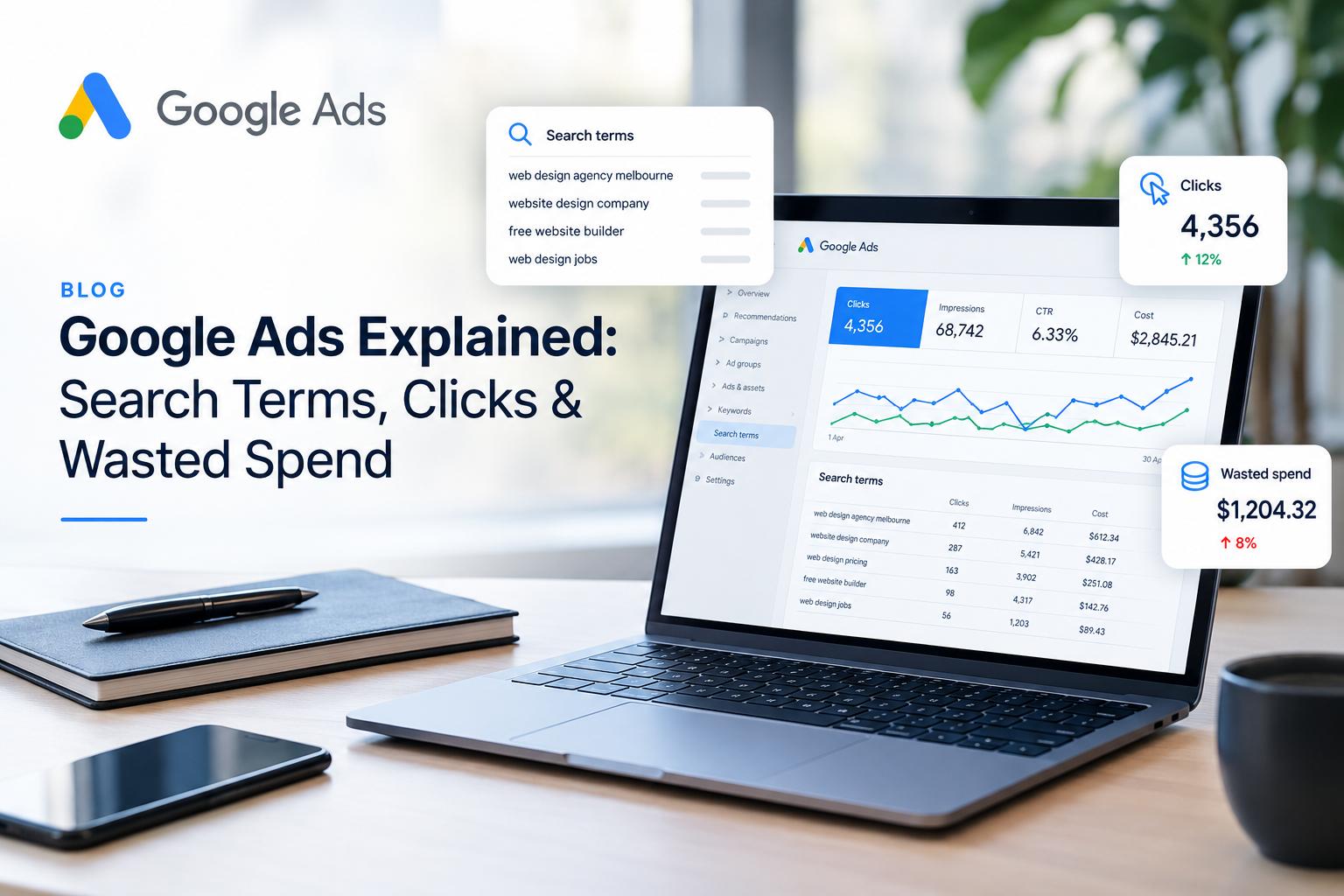
Google Ads gives businesses the opportunity to connect with people actively searching for products and services. However, getting users to click on an advertisement is only one part of an effective paid advertising strategy.
For businesses committing substantial budgets to digital marketing, understanding why ads appear, what attracts users and how those interactions translate into business results is essential. Without clear performance data, campaigns can attract plenty of visitors without generating the enquiries, sales or qualified leads needed to justify the investment.
This is why Google Ads reporting and analysis play such an important role. By examining search terms, click activity, conversion tracking and campaign performance, businesses can identify opportunities to improve targeting, reduce unnecessary expenditure and direct their budgets towards more valuable traffic.
At IT BOOST Australia, we look beyond website visits when evaluating digital marketing performance. Effective Google Ads management involves understanding customer intent, measuring meaningful actions and ensuring the website experience supports the conversion process.
Google Ads Keywords and Search Terms: Understanding the Difference
Keywords and search terms are fundamental to Google Ads, but they describe two different parts of the advertising process. Understanding how they work together helps businesses improve targeting and identify searches that may not be worth paying for.
Keywords are the terms advertisers choose when setting up their campaigns. Search terms are the actual words or phrases users enter into Google that may trigger an advertisement. Google's search terms reporting guide explains how advertisers can review this information.
Consider a web design agency targeting the keyword "web design agency". Depending on its match type and campaign settings, the advertisement could appear for searches such as:
- Web design agency Melbourne
- Enterprise web design agency
- Web design agency pricing
- Free website builder
- Web design agency jobs
Although these searches share similar wording, the people behind them may have very different objectives.
Someone searching for an enterprise web design agency could be evaluating providers for a major business project. Another person looking for a free website builder may prefer a do-it-yourself solution, while someone searching for agency jobs is likely interested in employment rather than purchasing a service.
This highlights an important distinction: keywords help advertisers define their targeting, while search terms provide insight into what users are actually looking for.
Even a carefully planned keyword list can attract less relevant searches. Match types influence how closely a user's query needs to relate to a selected keyword, so advertisers should regularly examine search term reports instead of assuming their original targeting will always produce the right traffic.
Understanding Who Clicks Your Google Ads
Click data helps businesses understand how frequently their advertisements attract attention. However, the number of clicks alone does not establish the quality or commercial value of that traffic.
Some visitors may be comparing providers, researching a problem or looking for general information. Others may be searching for a product or service that the business does not offer. A click is therefore not necessarily a qualified lead or a genuine sales opportunity.
Google Ads does not generally identify every individual who clicks an advertisement by name. Instead, it provides reporting and aggregated data that advertisers can use to assess audience behaviour and campaign effectiveness.
Several reporting areas can help build a clearer picture.
Search Intent and User Needs
Search terms provide useful clues about the reason behind an ad interaction. Phrases containing words such as "pricing", "supplier", "enterprise solution" or "near me" may indicate different stages of the decision-making process.
These terms do not guarantee that someone is ready to purchase, but they can help businesses assess how closely incoming traffic aligns with their services and target customers.
For example, a company targeting enterprise website projects may discover that some of its advertising budget is being spent on searches for inexpensive website templates. This could indicate an opportunity to refine its keyword strategy or introduce suitable negative keywords.
Location and Device Performance
Location and device reports help advertisers examine where interactions occur and how users access their websites.
A business serving selected Australian cities can use location data to assess the geographic relevance of its advertising. Device reports may also reveal differences in engagement or conversion performance between desktop computers, tablets and mobile phones.
If mobile traffic generates clicks but few enquiries, the problem may not necessarily be the advertising itself. The landing page could be difficult to navigate on a smaller screen, the contact form might be cumbersome, or important information could be difficult to find.
Reviewing these details helps businesses identify potential improvements across both advertising and website usability.
Audience and Demographic Insights
Depending on the campaign type, available data and reporting thresholds, Google Ads can provide aggregated audience and demographic insights.
These reports can help advertisers recognise broader patterns among the people interacting with their campaigns. However, the information should not be interpreted as a way to identify every individual visitor, and the level of detail available varies between campaigns.
Audience insights are most useful when considered alongside search intent, conversion behaviour and the business's target market.
Conversion Tracking and Lead Quality
Conversion tracking helps businesses measure actions that matter, including completed enquiry forms, phone calls, purchases and other defined outcomes.
For lead generation campaigns, however, recording an enquiry is only the beginning. The next step is to determine how many enquiries represent suitable sales opportunities.
A campaign producing fewer enquiries may deliver stronger results if those enquiries are more relevant and more likely to become paying customers. Conversely, a campaign generating a high volume of leads may be less valuable if most prospects fall outside the business's target market.
The objective is to understand which advertising interactions contribute to meaningful outcomes, rather than simply counting clicks.
How to Find and Reduce Wasted Google Ads Spend
Wasted advertising expenditure can arise when campaigns attract irrelevant searches, reach people outside the intended service area or direct visitors to pages that do not meet their needs.
Identifying the cause is important because different problems require different solutions. Adjusting keywords will not resolve a poor landing page, just as redesigning a website will not necessarily fix irrelevant search targeting.
A structured review can help businesses distinguish between these issues.
Identify Irrelevant Search Terms
Begin by reviewing the search terms that have triggered your advertisements. Look for queries that do not align with your products, services or target audience.
Depending on the business, these could include job vacancies, free alternatives, training resources or services that are not offered.
Negative keywords can help prevent advertisements from appearing for unsuitable searches. However, they should be applied carefully. Excluding a broad or ambiguous term may also prevent your ads from appearing for relevant searches, so the context of each query needs to be considered.
Regular search term reviews help keep targeting aligned with commercial objectives as campaigns accumulate data.
Review Keyword Match Types
Different keyword match types affect the searches eligible to trigger an advertisement. Reviewing their performance can help advertisers understand how much reach their campaigns are generating and how relevant that traffic is.
Broad match can uncover useful search opportunities beyond the exact wording of a selected keyword. At the same time, it requires appropriate campaign settings, reliable conversion measurement and ongoing monitoring.
The aim is not to restrict every variation in search behaviour. It is to find the right balance between reaching potential customers and avoiding unnecessary expenditure.
Check Geographic Targeting Settings
Geographic targeting should reflect the locations a business can realistically serve.
For example, a Melbourne-based service provider may not benefit from paying for enquiries from locations outside its operating area. Reviewing location settings and available geographic reports can help identify potential mismatches.
Advertisers should also understand the location options selected in their campaigns, as these settings influence which users may be eligible to see their advertisements.
Investigate Unusual Click Activity
Sudden increases in clicks, rising costs without corresponding engagement or repeated low-quality enquiries may indicate a need for further investigation.
These patterns alone do not establish that invalid traffic is occurring. Google automatically filters many invalid clicks, including certain accidental, duplicate and automated interactions. Advertisers can also review available invalid click metrics and use Google's support processes if concerns persist.
The important step is to investigate unusual performance using the available evidence rather than immediately assuming every unexpected click represents fraud.
Evaluate the Landing Page Experience
A campaign can attract the right audience and still underperform if the destination page does not encourage visitors to take the next step.
Common problems include slow loading times, unclear messaging, poor mobile usability, confusing navigation and a mismatch between the advertisement and the page content.
Review the visitor's journey from the initial search through to the landing page. Does the page address the reason they clicked? Are the service details easy to understand? Is the enquiry process straightforward?
Improving these elements can help businesses get more value from relevant traffic without relying exclusively on additional advertising spend.
Measuring Google Ads Success Beyond Clicks
Clicks, impressions and click-through rate provide useful information about how advertisements perform. However, they do not show the complete commercial picture.
For established businesses, reporting should connect advertising activity with outcomes that support revenue, sales and broader business objectives.
Several metrics can help provide that context.
Conversion rate: The proportion of measured ad interactions that result in a defined conversion, depending on how the metric is configured.
Cost per conversion: The advertising cost associated with each recorded conversion.
Qualified lead rate: The proportion of enquiries that meet the business's criteria for a suitable sales opportunity.
Cost per qualified lead: The advertising expenditure associated with generating a qualified prospect.
Conversion value and revenue: The value attributed to purchases or other measurable business outcomes when suitable tracking is available.
These figures should be assessed together rather than in isolation. A low cost per lead may appear attractive, but the result is less meaningful if most enquiries are irrelevant. Similarly, a campaign with a higher acquisition cost may still provide a stronger return if it consistently attracts customers with greater commercial value.
Reliable conversion tracking is central to this process. If important actions such as form submissions, phone calls or purchases are not recorded correctly, campaign reports may not reflect actual performance. Conversion data can also influence automated bidding, making accurate measurement particularly important for campaigns that rely on Google's optimisation systems.
For larger organisations, the analysis may need to extend beyond Google Ads itself. Connecting campaign data with customer relationship management (CRM) systems, sales records and revenue reporting can help businesses understand which advertising activities contribute to valuable customers.
This requires clear conversion definitions and a considered measurement framework. Simply recording every form submission as an equal conversion may not provide the insight needed to make sound budget decisions.
Why Search Term Analysis Matters for Larger Organisations
Search term analysis becomes increasingly important as businesses expand their advertising across multiple services, locations, product categories or customer segments.
A campaign that performs well in one market may produce different results in another. Search intent, competition, customer value and conversion behaviour can all vary depending on the offering and audience.
For example, a national business advertising several services across Australian cities may discover that one campaign consistently generates relevant enquiries, while another attracts substantial traffic with few suitable leads.
The appropriate response could involve refining negative keywords, adjusting campaign segmentation, improving landing pages or reallocating budget. The decision should be guided by the available data and the commercial priorities of each campaign.
A consistent optimisation process also helps internal marketing teams and external agencies work towards the same objectives. Regular reporting, clearly defined conversion actions and documented account changes make it easier to evaluate performance over time.
For enterprise advertising, effective management is not simply about operating a larger number of campaigns. It is about maintaining visibility, reliable measurement and strategic control as the account becomes more complex.
How IT BOOST Australia Helps Businesses Improve Google Ads Performance
At IT BOOST Australia, we consider the relationship between advertising, website performance, SEO and the customer journey. Each component influences how effectively a business can turn its digital marketing investment into meaningful results.
Our approach to Google Ads management focuses on calibrating campaigns to work smarter, not harder. By aligning targeting, budget allocation and bidding strategies with business objectives, we aim to make better use of advertising budgets and attract higher-quality leads instead of simply pursuing more clicks.
We also assess what happens after a visitor arrives on the website. Landing page relevance, mobile usability, page structure and the clarity of the next step can all influence the likelihood of an enquiry or sale.
Our experience across web design, custom web development and SEO allows us to consider opportunities beyond the advertising account. If a campaign attracts relevant visitors but the website struggles to convert them, improving the landing page or underlying website experience may be just as important as refining the campaign settings.
For businesses with more complex requirements, this can also involve reviewing how advertising reports align with lead quality, sales processes and broader commercial objectives.
We focus on practical improvements supported by data, with the goal of building a more efficient and measurable Google Ads strategy that makes better use of your budget and supports sustainable business growth.
Make Your Google Ads Budget Work More Effectively
Understanding search terms, click behaviour and wasted spend gives businesses a stronger foundation for managing Google Ads. It helps identify irrelevant traffic, uncover useful search opportunities and assess how effectively campaigns contribute to business outcomes.
For organisations investing in paid search, consistent reporting and ongoing optimisation can improve visibility into campaign performance and highlight opportunities to use budgets more efficiently.
If your Google Ads campaigns are generating clicks but not enough suitable enquiries, reviewing your targeting, conversion tracking and website experience can help identify where improvements may be needed.
Contact IT BOOST Australia to discuss your Google Ads management and broader digital marketing requirements.
Disclaimer
This article is provided free of charge for public information. We do not guarantee, and accept no legal liability for, the accuracy, reliability, currency, or completeness of the content or any linked material. Users should apply their own judgment and verify the material’s relevance to their needs. This article is a general summary and not a substitute for legal or professional advice. Users should seek appropriate advice for their circumstances. Any third-party views expressed do not necessarily reflect ours or imply endorsement.